

Sesen Launches SesenGPT Benchmark Program to Help Life Sciences Companies Improve Translation Quality and Reduce Costs
Sesen, the Life Sciences Translation Company
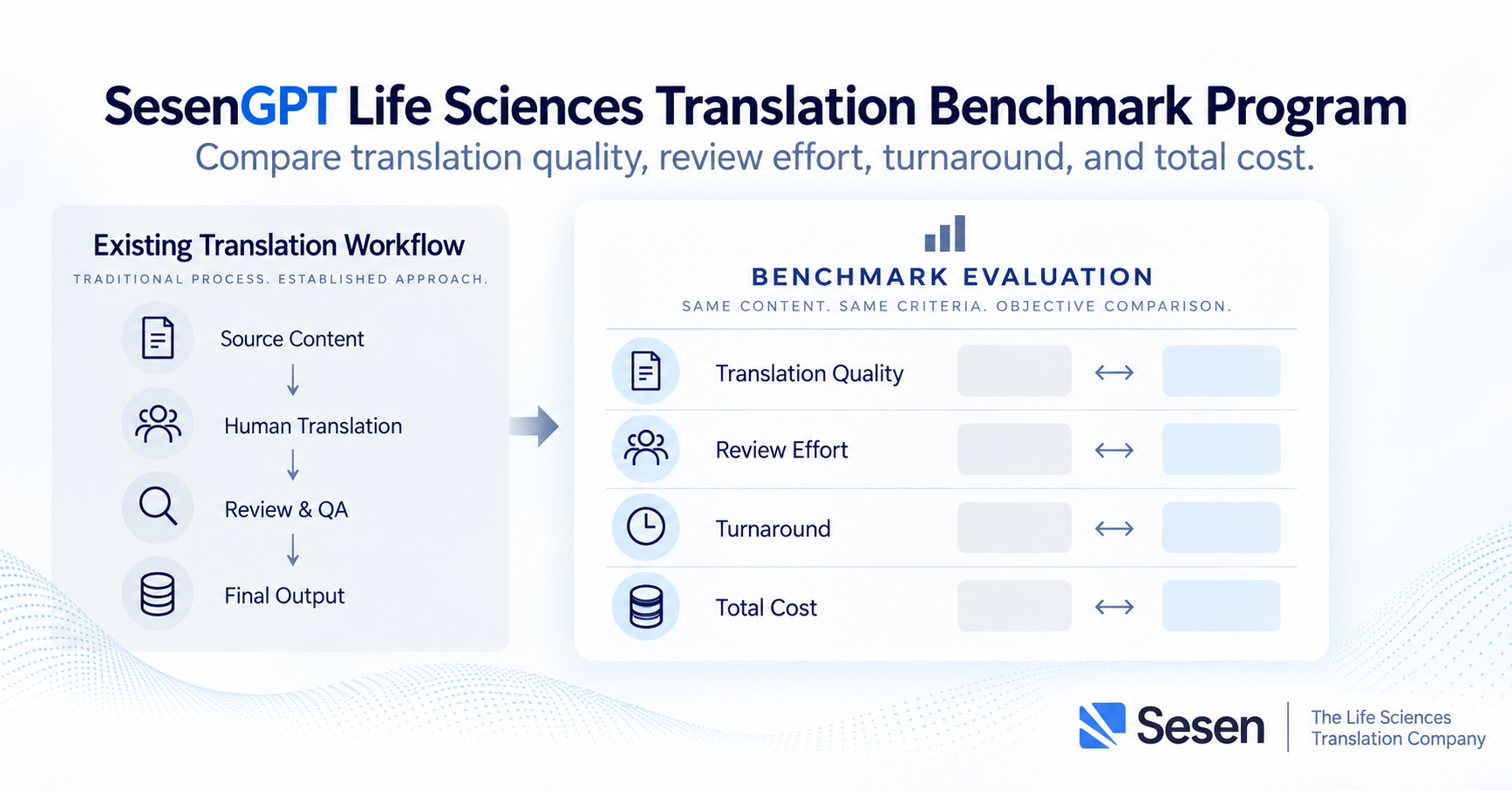
Sesen launches the SesenGPT Life Sciences Translation Benchmark Program, enabling life sciences companies to compare translation quality, review effort, turnaround, and total cost.
New program lets life sciences companies compare SesenGPT translation quality, costs, and review effort with existing workflows using their own content.
BOSTON, MA, UNITED STATES, October 15, 2026 /EINPresswire.com/ -- Sesen, the Life Sciences Translation Company, today announced the launch of its SesenGPT Life Sciences Translation Benchmark Program, a structured evaluation initiative designed to help pharmaceutical, biotechnology, medical device, and contract research organizations (CROs) assess opportunities to improve translation quality, reduce costs, and increase operational efficiency through advanced AI-enabled workflows.The program enables organizations to compare SesenGPT-powered translation workflows with their existing translation processes using representative clinical, regulatory, scientific, and technical content. Through defined evaluation criteria and qualified linguistic review, participants can assess translation accuracy, terminology consistency, human review effort, turnaround, and total cost per accepted deliverable.
Moving Beyond AI Translation Claims to Measurable Results
As AI reshapes enterprise translation and localization, life sciences organizations are exploring new ways to improve multilingual content efficiency while maintaining the accuracy, consistency, and quality controls essential for regulated materials.
However, evaluating AI translation for complex medical and scientific content requires more than comparing initial translation quality or processing speed. Organizations must assess technical accuracy, adherence to approved terminology, numerical precision, and alignment with applicable regulatory requirements. They must also measure the human review and correction effort needed to produce a quality-assured final translation.
"The conversation around AI translation needs to move beyond promises of faster turnaround and lower costs," said Shunee Yee, President and CEO of Sesen. "Life sciences organizations need measurable evidence that AI can improve translation efficiency while maintaining the quality and accountability their content demands. Our SesenGPT Benchmark Program gives companies a practical way to evaluate these opportunities using their own content, quality standards, and business requirements."
A Structured, Evidence-Based Approach to Translation Benchmarking
The SesenGPT Benchmark Program evaluates translation performance across representative documents, selected language pairs, and agreed quality requirements.
Participating organizations can compare their existing translation workflows with SesenGPT-enabled processes that combine life sciences-adapted AI, customer-specific terminology, approved translation memory, specialized medical linguists, and structured quality assurance.
Depending on the evaluation scope and available baseline data, the program assesses six performance dimensions:
• Translation Accuracy and Quality: Scientific and technical accuracy, completeness, and critical translation errors.
• Terminology and Regulatory Relevance: Adherence to approved terminology and applicable regulatory content requirements.
• Numerical and Technical Precision: Accuracy of dosages, measurements, units, warnings, and technical instructions.
• Human Review and Correction Effort: Editing requirements, reviewer time, and corrections needed to achieve the agreed quality threshold.
• Turnaround and Workflow Efficiency: End-to-end translation, review, quality assurance, and delivery performance.
• Total Translation Cost: Production, review, and correction costs, including total cost per accepted deliverable where comparable data are available.
Evaluation criteria are established before the benchmark begins, with comparisons designed to account for content complexity, language pairs, reference materials, and review requirements.
Qualified reviewers assess translation quality using agreed criteria, with reviewers separate from translation production where practicable. The evaluation also identifies limitations in available baseline data to help ensure that comparisons are meaningful.
Purpose-Built for Complex Life Sciences Content
Powered by SesenGPT, Sesen's controlled AI translation infrastructure, the program supports evaluations involving a broad range of specialized life sciences documentation.
These include clinical trial translation services for protocols, informed consent forms, investigator materials, and patient communications; regulatory translation services for submissions, health authority correspondence, and controlled regulatory documentation; and medical device translation services for instructions for use (IFUs), product labeling, technical documentation, and medical device software.
Additional applications include pharmaceutical labeling, pharmacovigilance materials, biotechnology documentation, electronic clinical outcome assessments (eCOA), and digital health content.
Unlike standalone AI translation tools, SesenGPT operates within controlled workflows incorporating approved language assets, selective AI-assisted translation, qualified medical linguist review, and validation-driven quality checks.
The benchmark recognizes that different content types carry different levels of risk. Its objective is not to assume that AI will outperform every existing workflow, but to identify where AI-enabled translation can deliver measurable advantages and where additional human expertise and quality controls remain essential.
Actionable Findings Without Disrupting Existing Translation Programs
The SesenGPT Benchmark Program provides organizations with a practical way to evaluate new translation capabilities without replacing their current language service providers or overhauling their localization infrastructure.
Following the evaluation, participants receive a findings summary covering the agreed performance measures, translation quality observations, available cost and efficiency comparisons, and recommendations for potential next steps.
These findings can help organizations identify suitable applications for AI-enabled translation, opportunities to reduce internal review effort, and areas where additional controls or human-led translation remain preferable.
Confidentiality requirements, approved content-transfer arrangements, and necessary agreements are established before project materials are exchanged. Benchmark scope, schedule, and participation terms are determined based on each organization's evaluation requirements.
By introducing a structured approach to comparing AI-enabled translation performance, Sesen aims to help life sciences organizations make better-informed decisions about translation quality, workflow efficiency, and localization costs.
Life sciences organizations interested in participating can learn more about the SesenGPT Life Sciences Translation Benchmark Program and request an evaluation at www.sesen.com/sesengpt/benchmark/.
About Sesen
Sesen, the Life Sciences Translation Company, provides specialized translation and localization services for pharmaceutical, biotechnology, medical device, contract research organization (CRO), and healthcare companies worldwide. Its solutions support clinical trials, regulatory submissions, pharmaceutical labeling, medical device documentation, pharmacovigilance, and digital health content.
Combining professional medical and scientific linguists with SesenGPT-powered AI workflows, terminology governance, and ISO-certified quality processes, Sesen helps organizations improve multilingual content quality, consistency, and efficiency across more than 150 languages.
For more information, visit www.sesen.com.
Sesen Communications
Sesen
+1 617-263-8950
Legal Disclaimer:
EIN Presswire provides this news content "as is" without warranty of any kind. We do not accept any responsibility or liability for the accuracy, content, images, videos, licenses, completeness, legality, or reliability of the information contained in this article. If you have any complaints or copyright issues related to this article, kindly contact the author above.
