

Chinese Academy of Sciences Study Uncovers Hidden Drivers of Haze Pollution
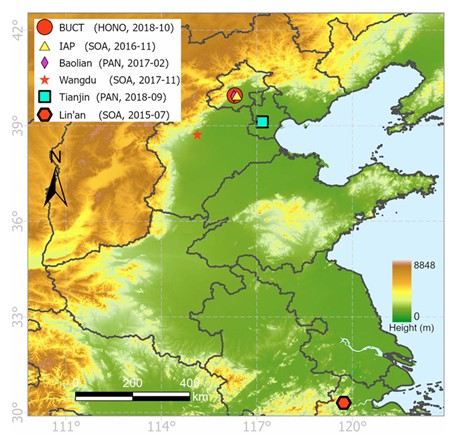
WRF-Chem modeling shows aerosol-related nitrous acid (HONO) sources strongly enhance secondary organic aerosols (SOA) and peroxyacetyl nitrates (PAN) formation compared to surface emissions.
New modeling research shows aerosol-related HONO sources strongly amplify SOA and PAN formation across China
BOSTON, MA, UNITED STATES, May 27, 2026 /EINPresswire.com/ -- Nitrous acid (HONO) is a key precursor to atmospheric hydroxyl radicals that drive formation of secondary pollutants such as ozone, secondary organic aerosols (SOA), and peroxyacetyl nitrates (PAN). A new study uses WRF-Chem modeling and field observations across China to assess how HONO sources influence pollution. Results show that aerosol-related sources, especially nitrate photolysis, have a disproportionately strong effect on SOA and PAN formation despite smaller surface HONO contributions, highlighting critical role in haze chemistry.Air pollution in China and many other rapidly industrializing regions is strongly influenced by complex atmospheric chemistry that transforms primary emissions into secondary pollutants such as ozone, secondary organic aerosols (SOA) and peroxyacetyl nitrate (PAN). A key driver of this chemistry is nitrous acid (HONO), a short-lived atmospheric compound that rapidly photolyzes under sunlight to produce hydroxyl (OH) radicals. These radicals act as the “detergent” of the atmosphere, initiating oxidation reactions that lead to haze formation and secondary pollution.
Although HONO is known to significantly enhance atmospheric oxidation capacity, its sources remain highly uncertain. Traditional understanding has focused on ground-level processes such as traffic emissions and heterogeneous reactions of nitrogen dioxide (NO₂) on surfaces. However, these known sources cannot fully explain observed HONO levels, suggesting that additional pathways (involving aerosols and photochemistry) may play a much larger role than previously assumed.
A new study led by Professor Junling An from the Institute of Atmospheric Physics, Chinese Academy of Sciences, China, and Professor Weigang Wang from the School of Chemical Sciences, University of Chinese Academy of Sciences, China, used the WRF-Chem atmospheric model in combination with field observations from six sites across China (2015–2018) to systematically evaluate how different HONO sources influence secondary pollutant formation. The study incorporated six major HONO pathways, including traffic emissions, soil emissions, indoor–outdoor exchange, nitrate photolysis, and heterogeneous reactions of NO₂ on aerosol and ground surfaces. The paper was made available online on February 22, 2025, and was published in Volume 158 of the Journal of Environmental Sciences on December 1, 2025.
Unlike earlier studies that mainly focused on how these sources contribute to total HONO concentrations, this work asked a more critical question: how much each source actually enhances secondary pollution, such as SOA and PAN? To answer this, the researchers introduced an “enhancement ratio” to quantify the ability of each HONO source to amplify secondary pollutant formation relative to its contribution to HONO itself.
The simulations revealed a major mismatch between HONO concentration sources and their actual atmospheric impact. Ground-level heterogeneous reactions on ground surfaces (Het_g) were found to dominate near-surface HONO concentrations, accounting for up to 50–70% in urban Beijing. However, these sources did not necessarily produce the strongest effects on secondary pollution formation.
Instead, aerosol-related processes, like particulate nitrate photolysis (P_nit), showed the highest efficiency in enhancing secondary pollutants. Although P_nit contributed only a small fraction (about 1–12%) to near-surface HONO levels, its enhancement ratio for SOA and PAN reached approximately 7, far exceeding other sources. This means that nitrate photolysis, despite its modest contribution to measured HONO, plays a disproportionately large role in driving atmospheric oxidation and haze formation.
“Our findings clearly show that surface HONO measurements alone cannot represent the true atmospheric impact of different sources,” says Prof. An. “Aerosol-related pathways, especially nitrate photolysis, are far more influential in shaping secondary pollution than previously recognized.”
The study also highlighted significant vertical differences in HONO chemistry. While traffic and ground emissions mainly influenced near-surface air and decayed rapidly with altitude, aerosol-related sources remained active throughout the lower and middle troposphere. This allowed them to sustain OH radical production over a much larger vertical range, significantly enhancing regional atmospheric oxidation capacity.
Model results showed that including all six HONO sources greatly improved simulations of polluted haze episodes. During winter pollution events, simulated PAN concentrations increased by up to 200–400%, bringing model predictions much closer to observed values. SOA concentrations also more than doubled at several observation sites when all HONO sources were included, although some underestimation still remained due to missing chemical pathways in the model.
Prof. Wang emphasized the broader implications: “We need to rethink how we evaluate emission control strategies. Reducing surface emissions alone may not effectively limit secondary pollution if aerosol-driven photochemical processes are not addressed.”
Another key finding was that the spatial distribution of HONO sources strongly influences their regional impact. Traffic and indoor emissions were highly localized and thus had limited influence on regional-scale pollution formation, whereas aerosol-related sources were more widely distributed and chemically active across different atmospheric layers.
“The study demonstrates that HONO chemistry is far more complex than previously understood. It is not simply the amount of HONO that matters, but where it is produced, how it evolves vertically, and how efficiently it drives radical chemistry,” says Prof. An.
These insights provide an important step forward in understanding haze formation and improving air quality models for future pollution mitigation strategies.
***
Reference
Title of original paper: Inconsistent capacity of potential HONO sources to enhance secondary pollutants: Evidence from WRF-Chem modeling
Journal: Journal of Environmental Sciences
DOI: 10.1016/j.jes.2025.02.023
About the Chinese Academy of Sciences, China
The Chinese Academy of Sciences (CAS) is China’s national academy for natural sciences and one of the world’s leading research organizations. Founded in 1949 and headquartered in Beijing, CAS brings together a vast network of research institutes, universities, and innovation centers across a wide range of scientific fields, including environmental science, physics, chemistry, biology, information technology, and space science. Through interdisciplinary research, international collaboration, and advanced scientific infrastructure, CAS supports scientific discovery and technological innovation aimed at addressing global challenges and advancing sustainable development.
Website: https://english.cas.cn/
About Professor Junling An from the Institute of Atmospheric Physics, Chinese Academy of Sciences, China
Dr. Junling An is a professor at the Institute of Atmospheric Physics, Chinese Academy of Sciences. His research focuses on atmospheric chemistry, air pollution, aerosol processes, and air quality modeling. Through atmospheric observations, chemical transport modeling, and environmental analysis, his work advances the understanding of pollutant formation, regional haze, and the interactions between atmospheric chemistry and climate.
About Professor Weigang Wang from the University of Chinese Academy of Sciences, China
Dr. Weigang Wang is a professor at the Institute of Chemistry, Chinese Academy of Sciences. His research interests include analytical chemistry, environmental chemistry, and advanced measurement techniques for studying atmospheric particles and complex chemical systems. His work supports the development of innovative approaches for understanding environmental processes and improving pollution monitoring and analysis.
Funding information
This work was supported by the National Natural Science Foundation of China (grant numbers: 92044302, 42075108, 42107124, 41822703, 91544221, 91844301, and 22222610), Beijing National Laboratory for Molecular Sciences (grant number: BNLMS-CXXM-202011), and the Natural Science Foundation of Yunnan Province (grant number: 202302AN360006).
Hanqin Tian
Boston College
+1 617-552-3664
hanqin.tian@bc.edu
Legal Disclaimer:
EIN Presswire provides this news content "as is" without warranty of any kind. We do not accept any responsibility or liability for the accuracy, content, images, videos, licenses, completeness, legality, or reliability of the information contained in this article. If you have any complaints or copyright issues related to this article, kindly contact the author above.
