

Intelligent Vending Machine Market to Hit USD 53.2 Billion by 2036, Asia Pacific Leads with CPI & Azkoyen Driving Growth
Intelligent Vending Machine Market
AI-powered vending machines transform retail with IoT, cashless payments, and smart cities, driving 11.6% CAGR growth through 2036 globally.
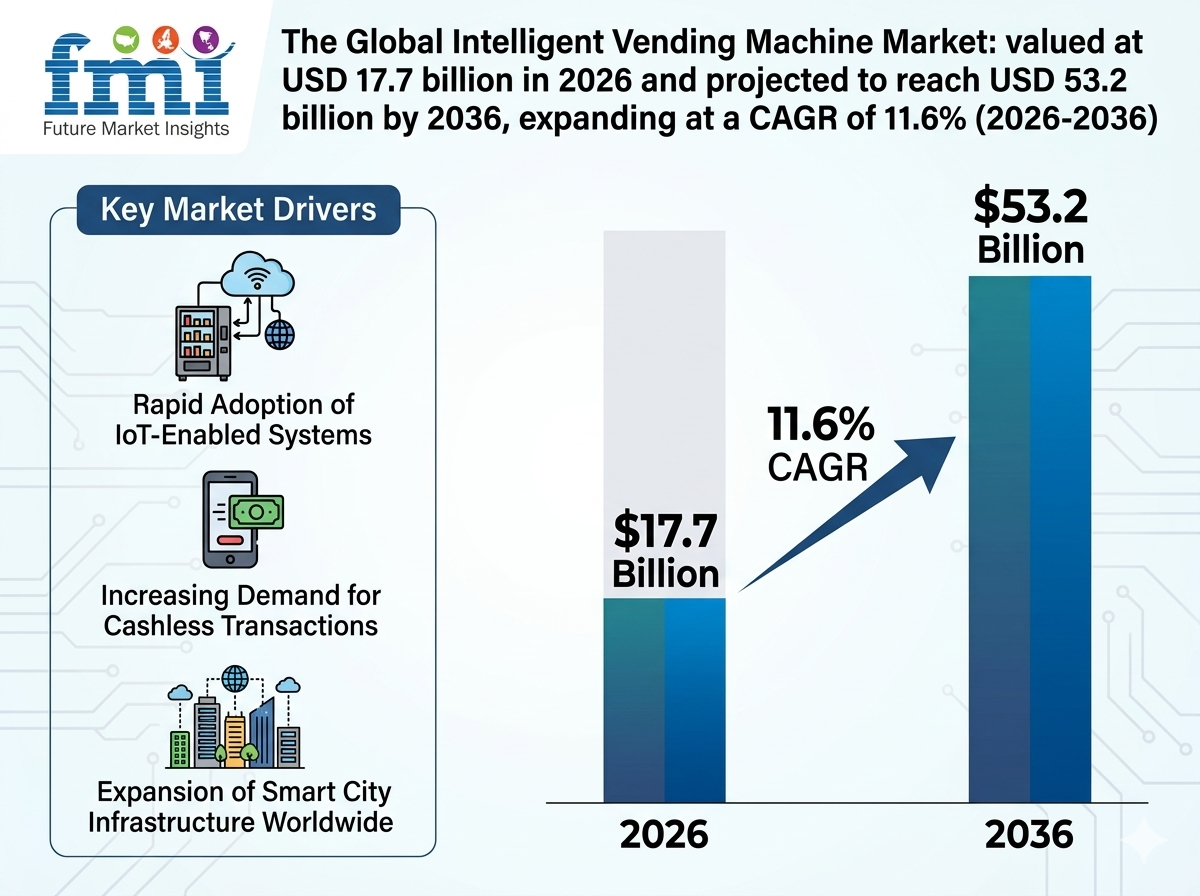
NEWARK, DE, UNITED STATES, April 2, 2026 /EINPresswire.com/ -- The global Intelligent Vending Machine Market is valued at USD 17.7 billion in 2026 and is projected to reach USD 53.2 billion by 2036, expanding at a CAGR of 11.6% from 2026 to 2036. Growth is driven by rapid adoption of IoT-enabled systems, increasing demand for cashless transactions, and the expansion of smart city infrastructure worldwide.
As consumer behavior shifts toward convenience-driven retail, intelligent vending machines are evolving beyond traditional dispensing systems into fully automated, AI-powered micro retail hubs. With integrated analytics, real-time inventory tracking, and interactive user interfaces, these systems are transforming how consumers engage with retail in high-traffic environments.
Request For Sample Report | Customize Report | Purchase Full Report
https://www.futuremarketinsights.com/reports/sample/rep-gb-4154
Intelligent Vending Machine Market Snapshot (2026–2036)
• Market size in 2026: USD 17.7 billion
• Market size in 2036: USD 53.2 billion
• CAGR (2026–2036): ~11.6%
• Leading machine type: Free-standing machines (58%)
• Dominant product segment: Beverages (32.0%)
• Top application: Airports & railway stations (34.7%)
• Key growth regions: India, China, Japan
• Key companies: Fuji Electric, CPI, Azkoyen Group, Sanden Corporation
Market Momentum
The intelligent vending machine market begins at USD 17.7 billion in 2026, supported by strong demand for contactless retail and digital payment systems. Between 2027 and 2030, increasing deployment across metro stations, airports, and corporate spaces accelerates adoption, driven by advancements in IoT connectivity and AI-powered analytics.
Entering 2032 and beyond, the integration of smart city infrastructure, predictive maintenance technologies, and computer vision-based self-checkout systems further strengthens market expansion. By 2036, the market reaches USD 53.2 billion, fueled by the widespread deployment of autonomous retail solutions across urban ecosystems, transportation hubs, and commercial environments.
Why the Market is Growing
The Intelligent Vending Machine Market is expanding as businesses and municipalities prioritize automation, efficiency, and consumer convenience. The integration of IoT and AI technologies enables machines to track inventory in real time, reduce downtime through predictive maintenance, and personalize user experiences.
The growing preference for cashless payments is a major growth catalyst, with operators increasing investments in digital payment systems by over 25% to align with rising adoption of mobile wallets and contactless transactions. These capabilities reduce transaction friction, increase sales volumes, and improve operational efficiency.
Additionally, smart vending machines are playing a pivotal role in smart city ecosystems. Governments are deploying multifunctional kiosks that combine vending with Wi-Fi hotspots, digital signage, and recycling units, creating new revenue streams and public utility value.
Segment Spotlight
1. Machine Type: Free-Standing Machines Lead Market Share
Free-standing machines dominate with a 58% share, driven by their flexibility, high storage capacity, and suitability for diverse environments. Their modular design allows easy customization and supports higher transaction volumes.
2. Product Type: Beverages Maintain Dominance
Beverages hold 32.0% of the market, supported by consistent global demand for convenient hydration solutions. Innovations such as smart refrigeration and customizable drink options further strengthen this segment.
3. Application: Airports & Railway Stations Lead
Airports and railway stations account for 34.7% share, driven by high footfall and the need for 24/7 accessibility. These locations justify premium vending solutions with enhanced security and product diversity.
Drivers, Opportunities, Trends, Challenges
Drivers:
• Rising demand for contactless and automated retail
• Expansion of smart cities and urban infrastructure
• Growth in digital payment ecosystems
Opportunities:
• Integration with AI and computer vision technologies
• Expansion into healthcare and fresh food vending
• Growth of micro-market and unattended retail models
Trends:
• Shift toward cashless and mobile wallet payments
• Adoption of predictive maintenance reducing downtime by 30%
• Expansion of non-traditional vending products including electronics and pharmaceuticals
Challenges:
• High initial deployment costs
• Data privacy and regulatory concerns (GDPR compliance)
• Complexity in retrofitting legacy vending systems
Country Growth Outlook (2026–2036)
India leads the market with a CAGR of 14.9%, driven by rapid digital payments adoption and urban infrastructure growth. China follows at 13.8%, supported by advancements in AI, facial recognition, and unmanned retail ecosystems. Japan (12.4%) continues to innovate in vending density and community services, while the USA (11.9%) focuses on automation amid labor shortages. Germany records a CAGR of 10.8%, emphasizing energy-efficient and eco-friendly vending solutions.
Competitive Landscape
The market is highly competitive, with leading manufacturers focusing on integrating AI, IoT, and cloud-based analytics into vending systems. Companies are increasingly adopting software-as-a-service (SaaS) models to generate recurring revenue and enhance operational efficiency.
Innovation is centered on improving user experience through interactive displays, expanding payment integrations, and enhancing machine reliability through predictive diagnostics. Strategic partnerships with fintech firms and telecom providers are enabling seamless connectivity and payment processing.
Additionally, mergers and acquisitions are shaping the competitive landscape, as companies seek to integrate advanced technologies such as computer vision and edge analytics into their offerings.
Frequently Asked Questions (FAQ)
What is the global Intelligent Vending Machine Market size?
The market is valued at USD 17.7 billion in 2026 and is projected to reach USD 53.2 billion by 2036.
What is the expected growth rate?
The market is expected to grow at a CAGR of 11.6% from 2026 to 2036.
What are intelligent vending machines?
They are AI-enabled automated retail systems that use IoT, cashless payments, and real-time analytics to deliver products efficiently.
Why are intelligent vending machines gaining popularity?
They offer convenience, contactless transactions, reduced operational costs, and enhanced customer engagement.
Explore More Related Studies Published by FMI Research
Automotive Sensor Market
https://www.futuremarketinsights.com/reports/automotive-sensor-market
Industrial Automation Software Market
https://www.futuremarketinsights.com/reports/industrial-automation-software-market
Smart Retail Technology Market
https://www.futuremarketinsights.com/reports/smart-retail-technology-market
About Future Market Insights (FMI)
Future Market Insights, Inc. (FMI) is an ESOMAR-certified, ISO 9001:2015 market research and consulting organization, trusted by Fortune 500 companies and global enterprises. With a strong presence across the United States, United Kingdom, India, and the Middle East, FMI delivers actionable insights across 30+ industries and over 1,200 markets worldwide.
Why Choose FMI:
https://www.futuremarketinsights.com/why-fmi
Sudip Saha
Future Market Insights Inc.
+1 347-918-3531
rahul.singh@futuremarketinsights.com
Legal Disclaimer:
EIN Presswire provides this news content "as is" without warranty of any kind. We do not accept any responsibility or liability for the accuracy, content, images, videos, licenses, completeness, legality, or reliability of the information contained in this article. If you have any complaints or copyright issues related to this article, kindly contact the author above.
