

Iron Deficiency Anemia Therapy Market Set to Hit US$8.7 Bn by 2033 | Persistence Market Research
iron deficiency anemia (IDA) therapy market
Discover trends, growth drivers, and opportunities in the global iron deficiency anemia therapy market across regions and patient segments.
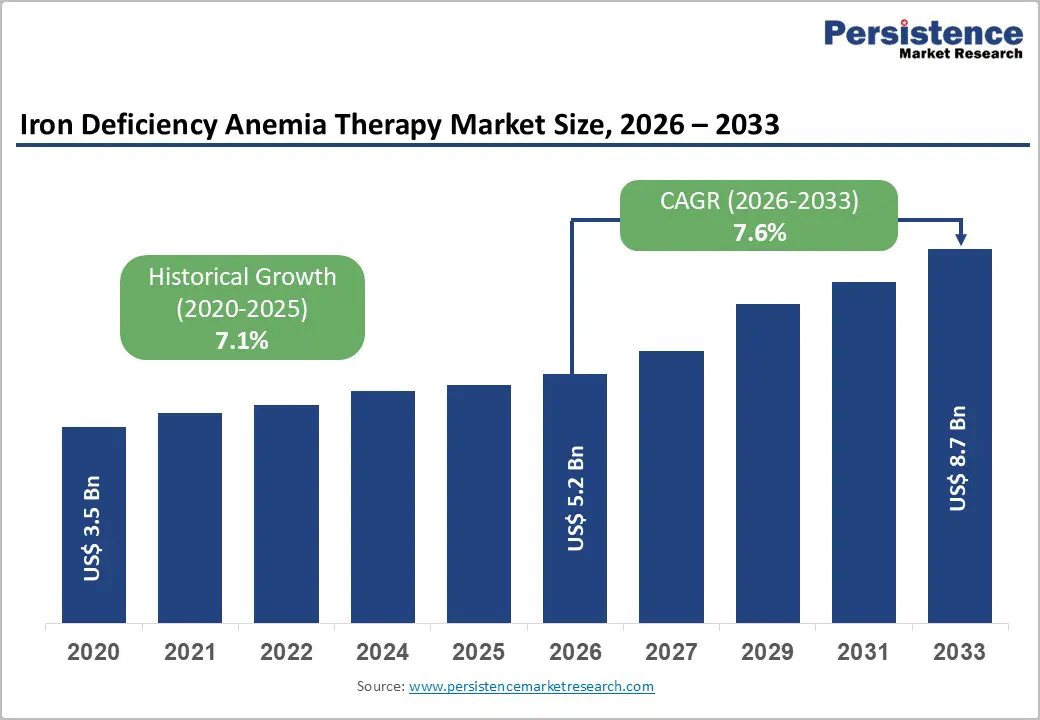
LONDON, UNITED KINGDOM, March 10, 2026 /EINPresswire.com/ -- The global iron deficiency anemia (IDA) therapy market is projected to grow significantly over the coming years. Valued at US$ 5.2 billion in 2026, the market is expected to reach US$ 8.7 billion by 2033, growing at a CAGR of 7.6% from 2026 to 2033. Anemia is a critical health condition caused primarily by nutritional deficiencies, affecting nearly 30% of the global population. It is especially prevalent among women and children. The condition develops when hemoglobin levels drop due to insufficient iron intake, poor absorption, or chronic blood loss, leading to fatigue, weakness, and compromised immunity. High-risk groups include young children, adolescent girls, pregnant women, and postpartum mothers, highlighting the necessity for effective therapeutic interventions.
Download Your Free Sample & Explore Key Insights: https://www.persistencemarketresearch.com/samples/34729
Market Dynamics
Drivers
Rising healthcare expenditure, increasing disease prevalence, and pharmaceutical innovation are major growth drivers for the iron deficiency anemia therapy market. Enhanced investment in public and private healthcare has improved hospital infrastructure, diagnostic availability, and access to specialty drugs. Expanded insurance coverage and maternal-child health programs support therapy adoption, particularly among vulnerable populations. Additionally, population aging, sedentary lifestyles, and chronic conditions such as gastrointestinal disorders and renal diseases increase anemia susceptibility, maintaining steady demand for oral and intravenous iron formulations. Public awareness campaigns, physician education programs, and government nutrition initiatives further stimulate early detection and treatment, while advancements in drug formulations—offering better absorption, fewer side effects, and simplified dosing—boost patient compliance.
Restraints
Despite strong growth, certain barriers limit market potential. Shortages of trained healthcare professionals, particularly in low- and middle-income countries, restrict accurate diagnosis and treatment. Limited laboratory infrastructure and specialist availability delay therapy initiation, reducing patient engagement. High costs of intravenous iron and branded formulations, coupled with weak reimbursement frameworks, hinder adherence and completion of treatment. Supply chain limitations and uneven distribution networks, especially in rural areas, further constrain market penetration.
Opportunities
The market offers growth opportunities through innovation and expansion into underserved regions. Pharmaceutical companies are introducing new oral and injectable iron therapies with improved safety and convenience. Regulatory approvals for biosimilar alternatives are enhancing affordability. Underserved regions such as Asia Pacific, Latin America, the Middle East, and Africa present significant growth potential due to large untreated populations and rising public health initiatives. Strategic partnerships, tiered pricing, and community screening campaigns can drive adoption and long-term revenue growth.
Get Custom Insights Designed for Your Business: https://www.persistencemarketresearch.com/request-customization/34729
Segment Analysis
By Age Group
Adults dominate the market, accounting for approximately 64%, driven by chronic illnesses, gastrointestinal disorders, heavy menstrual blood loss, and postoperative needs. Routine screening and outpatient infusion centers increase therapy uptake. The pediatric segment, however, is the fastest-growing due to school-based supplementation, maternal-child health programs, and child-friendly formulations such as syrups and chewable tablets. Rising birth rates and improved neonatal screening in emerging economies further boost demand.
By Distribution Channel
The market operates through hospital pharmacies, retail pharmacies, and online platforms. Hospitals are crucial for intravenous iron therapies and severe cases, while retail pharmacies serve oral supplements. Online pharmacies are gaining popularity due to convenience, competitive pricing, and subscription models. Government programs and public procurement systems remain important in developing regions. Multi-channel distribution strategies are helping companies maximize reach and accessibility.
Regional Insights
North America leads the market, supported by advanced healthcare systems, high per-capita medical spending, and extensive screening programs. The region is expected to hold around 37% of the global market share in 2026, with the U.S. contributing the majority. The growing geriatric population and lifestyle-related iron absorption issues further reinforce demand.
Asia Pacific is the fastest-growing region due to high disease prevalence, government health initiatives, and expanding healthcare infrastructure. Countries like India, China, Indonesia, and Vietnam have implemented large-scale nutrition programs and school supplementation schemes, boosting treatment volumes. Increased domestic pharmaceutical production is making therapies more affordable, while multinational partnerships are enhancing distribution efficiency.
Checkout Now & Download Complete Market Report: https://www.persistencemarketresearch.com/checkout/34729
Competitive Landscape
The market is highly competitive, with major companies focusing on oral and intravenous iron therapies. Key players include Akebia Therapeutics, Bayer AG, PHARMACOSMOS A/S, Sanofi, Johnson & Johnson, CSL Vifor, AbbVie, Novartis AG, GSK plc, AdvaCare Pharma, Apotex Inc., and Covis Pharma GmbH. Recent developments include Sandoz’s introduction of a cost-effective iron sucrose injection in the U.S. and Cadila Pharmaceuticals’ launch of an injectable iron supplement, reflecting ongoing innovation and market expansion.
Market Segmentation
By Product Type
Ferrous Sulphate
Ferrous Gluconate
Ferrous Fumarate
Ferric Hydroxide
Others
By Therapy Areas
Inflammatory Bowel Disease
Renal
Obstetrics and gynaecology
Congestive heart failure (CHF)
Oncology
Other
By Age Group
Adults
Paediatric
Geriatric
By Formulation
Tablets
Capsules
Liquids
Others
By Distribution Channel
Hospital Pharmacies
Retail Pharmacies
Online Pharmacies
By Region
North America
Europe
Asia Pacific
Latin America
The Middle East and Africa
Conclusion
The iron deficiency anemia therapy market is poised for robust growth driven by rising healthcare investment, technological innovation, and public health initiatives. Despite barriers like high treatment costs and limited specialist availability in emerging markets, the sector’s potential is reinforced by expanding screening programs, product innovation, and growth in underserved regions. The combined impact of demographic trends, policy support, and evolving distribution channels ensures sustained revenue growth across the global landscape through 2033.
Read Related Reports:
Sickle Cell Disease Treatment Market: Global sickle cell disease treatment market to grow from US$ 1.3 Bn in 2026 to US$ 1.9 Bn by 2033, driven by therapies, treatments, and diagnosis.
Hemoglobinopathy Market: The global hemoglobinopathy market is valued at US$888.6 million in 2026 and is expected to reach US$1,259.9 million by 2033, growing at a 5.1% CAGR.
Persistence Market Research
Persistence Market Research Pvt Ltd
+1 646-878-6329
email us here
Visit us on social media:
LinkedIn
Instagram
Facebook
YouTube
X
Legal Disclaimer:
EIN Presswire provides this news content "as is" without warranty of any kind. We do not accept any responsibility or liability for the accuracy, content, images, videos, licenses, completeness, legality, or reliability of the information contained in this article. If you have any complaints or copyright issues related to this article, kindly contact the author above.
